Author Archives: Allied Authors

First edition of AAW member’s litcrit book already a rarity

If you want the hardcover copy of John D. Haefele’s book about Wisconsin’s legendary author August Derleth, it’ll cost you.

“Collectors who didn’t get in fast may simply have to get in large,” cautions literary critic Don Herron, who examined the book’s Amazon.com ranking — as well as the going price for the first edition — on his popular blog, Up and Down These Mean Streets.

Derleth Mythos by John D. HaefeleOne copy of the book was listed at well over $1,000…

(Hopefully Herron’s warning does not apply to friends of Allied Authors of Wisconsin, who learned about Haefele’s A Look Behind the Derleth Mythos: Origins of the Cthulhu Mythos back in August of 2012.)

While the quality of Haefele’s work is certainly first-rate, the higher-than-expected prices are apparently due to a pricing algorithm used by a network that connects sellers of out-of-print books (such as AbeBooks) to industry giant Amazon, which automatically kicks in to maximize asking prices based on diminishing availability.

Amazon lists both new and used books for sale, so the real fun began when the combined total of Derleth Mythos available dropped below ten copies.

As available copies became fewer, the asking-prices for those still remaining continued to double — like the stock market’s buying frenzy and pricing feedback loop — until the last copy either was sold or pulled from the listings, all within a few days. Presumably, sellers outside the network then made changes to the pricing manually, and copies from sites such as eBay.com disappeared too.

Probably the extreme prices that popped up at the end did not represent the actual worth of the hard-to-find book. But since most of these books have either been traded or are archived in collections, a first-edition Derleth Mythos is undoubtedly worth more now than anyone paid for it new.

And the price is likely to climb further. Since the aforementioned frenzy, only one single copy has turned up for sale online, listed at nearly $700.

Fortunately, plenty of copies of the more affordable and improved second-edition of the book are available, issued by LMG Press, a newcomer that bears watching.


AAW’s Dorothy Tofte made many ripples

Anyone who had the pleasure of knowing Dorothy doesn’t need me to tell them how kind and gentle and generous and compassionate she was.

She also made ripples.

As people, we all change the world around us, at least a little.

We create ripples.

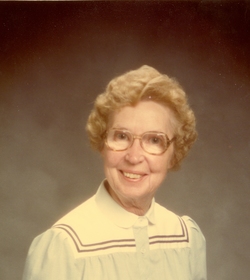
Dorothy Tofte

Dorothy Tofte

Some of us are Earth-shakers, and our ripples spread out and around and through history. And those ripples may be good or ill.

Most of us create more modest ripples. We have an impact on family and perhaps a few friends, possibly a co-worker or even a stranger now and then. Please understand, these modest, everyday, just-plain-folk ripples are an integral part of the societal oceans we inhabit, and without them we’re just isolated islands or bits of aimless driftwood. They’re essential, but modest.

And then…

…then there are a special few. Those whose ripples appear quiet and unassuming. They may come from people pleasant enough, kind even, but we may believe those ripples are certain to be short-lived and absolutely will not travel far.

Don’t be fooled. When created by those special few, those deceptively quiet ripples can go on and on and on.

I first met Dorothy in 1981 or ’82 when I was asked to take over an adult writing class she attended semester after semester. We hit it off—of course, she hit it off with everyone!—and she eventually invited me to be her guest at a writers group (ripples).

This wonderful group (two groups, in fact: Allied Authors and Fictioneers) included literary agent Larry Sternig as well as a host of other local literary luminaries. Larry offered to represent my fiction and garnered me my first appearance in a hard cover book (ripples). A few years later, health issues prompted him to offer me a partnership in the agency (ripples), and I took over the agency when Larry passed away in 1999 (ripples).

As an agent, I have had the pleasure of “starting” the publishing careers of nearly a dozen brand-new writers, and while they may have found an agent elsewhere and that agent may have sold their initial books and those sales may have been to the same publishers and may have entertained the same readers, Dorothy played a very real part in launching those writers’ careers (ripples).

Years ago, I invited a lifelong friend to join the Allied Authors of Wisconsin (the two groups had merged into one), and he has become a pivotal member. (Needless to say, he and Dorothy hit it off too).  He took upon himself the task of chronicling the group’s history, members past and present, publishing accomplishments and the group’s place in Wisconsin’s rich literary legacy.

He recently collected and collated the papers and history of Wisconsin’s renowned children’s book writer, Betty Ren Wright, and presented it to the state historical society, and he is doing similar work for other writers. If Dorothy had not invited me, I could not have invited him, and this treasury of information may well have been lost.

Ripples…

I have absolutely no doubt that Dorothy’s life above and beyond the narrow confines of my contact with her created other ripples. Ripples in the lives of her fellow nurses and healthcare professionals. Ripples in her patients’ lives, the lives of staff and her fellow residents at the Congregational Home, and doubtless uncounted ripples in the lives of complete strangers…anyone seeing her kind, always-smiling face could not help but smile in return and have a better day for it.

We are all the richer for having known her.

Dorothy Tofte passed away Nov. 19, 2014. Read the obituary here.

Jack Byrne contributed this article. 


Regardless of how, when and why — writers write

I was having lunch with another member of Allied Authors, and we began discussing writing — our writing — and we both admitted we weren’t doing much of that.

As I sat there and listened to myself, I realized what a phony I was. Because, people, writer’s write. If they don’t, they are not writers.

Duh.

And that brings me to this: When writers — successful ones, by which I mean published ones — speak of their challenges or how/when they write and their daily activities, each one, always, mentions having a daily schedule where he or she writes…wait for it…every day and usually at the same time of day.

These writers have different techniques. Some just write without knowing where they are going. They have the idea of a plot, but they let their characters tell them who they are and what’s going on. Some outline their novels first, and they tell their characters where they are going.

Again, both practices have led to success — published success — so that’s not the issue.

The issue is what is best for you and me.

Personally, I feel I have wasted much time and energy in “just writing.”

Now some would say there is no wasted time in “just writing” because that teaches us about what works and what doesn’t. Hey, okay. I like that idea…all the hundreds of pages I have written taught me something. To be honest (and don’t we love that comment, especially on court shows? “Judge, to be honest, I…” ), all those pages — some printed up sitting in boxes in the basement, some in my office and more recently taking up space in my computer — taught me something: I should outline my work and then write.

It’s time for me to get organized.

I have three novels written, all deeply flawed but, I believe, all with really interesting plots and characters. So what’s the problem? They don’t move. They don’t have the tension novels need to keep the reader interested.

Wow. I know. Now what do I do? Where do I go? Who’s on first.

Well, what I should do is quit writing about how/why/when to write and start writing.

First, a cup of coffee? Let the dog out?

You understand fully. And so do I. So will I or won’t I get to work? Will you?

I’ll keep you posted.

Maureen Mertens contributed this article.


AAW will miss beloved member Filomena Lea

Filomena Lea

Filomena Lea

Filomena Lea, a wife, mother, news reporter, published writer of fiction and personal experiences, a teacher of writing, has passed away, and we members of the Allied Authors of Wisconsin will miss her tremendously.

Filomena was a focused, hard-working woman who got the job done. She was also kind and considerate and helped those less fortunate. She passed away on July 25, 2014, at the age of 84.

I miss you, Filomena. I miss so very much, my dear friend.

Maureen Mertens contributed this article.


Need to break through writer’s block? Consider A&P!

Artists have their brushes, easels and sketchpads; carpenters, their saws, hammers and levels; musicians, their pitch pipes, scales and embrasures.

As writers, we too have many and varied tools. Some are straightforward, such as vocabulary, basic understanding of grammar, punctuation and spelling. Others are more individualized and abstract, including our areas of literary interest, personal backgrounds and writing goals. (A blockbuster novel? The perfect haiku? An Oscar-winning screenplay?)

And perhaps there are a few that are too slippery and nebulous for easy classification.

I’d like to discuss one that, in my opinion, could be the Swiss Army knife for fiction writers when it comes to decision making and/or problem solving: Audience and Purpose.

Years ago, while teaching classes, addressing groups or conducting seminars, I was eventually (and inevitably) approached by confused/frustrated/stalled writers at a loss for how to proceed with their story or novel. They didn’t know “what to do next” or “how to write this part” or “why this scene doesn’t work” or…fill in the blank.

For many, perhaps most of them, a simple-but-not-always-easy Audience and Purpose (A&P) exercise might have been able to break the block and clarify not only what needed to happen, but also how it needed to happen.

While this tool can be applied to any piece of fiction (and can be effectively applied to nonfiction as well), I’ll frame it in terms of writing a genre novel.

Ideally, a writer will have some basic idea of the type of material he is writing — mystery, romance, fantasy, etc. — and this presents a broad A&P framework. On the surface, the use of this tool may appear obvious and hardly worth note. A mystery novel’s Purpose, its overall reason for being, is to present the reader with a puzzle (usually a crime) of some sort and the eventual solution of that puzzle. Broadly speaking, a mystery novel’s Audience is comprised of those who enjoy mysteries.

Not exactly a breakthrough realization.

Taking it a step further is still rather straightforward. Readers seeking and expecting a nice, cozy whodunit comprise a somewhat different Audience from those seeking a hard-boiled, double-fisted, take-no-prisoners tale or readers with a yen for a detail-rich police procedural or any of the other guises a mystery might take. While the overall Purpose might be the same (present and then solve the puzzle), the Audience, and therefore the approach, will vary.

Okay…still pretty obvious. Big deal, right?

Let’s take it deeper. While the overall Purpose may be to solve that puzzle, it’s not the only thing that happens. (At least I hope not). There are characters to meet, settings to explore, moods to create, relationships to develop. While these sub-Purposes may be colored by the overall Purpose, they are not controlled by it.

If, for example, your protagonist develops an attraction to or even a relationship with another character, and you want your reader to “approve” and be happy for them, this short-term Purpose will dictate your literary decisions.

(Note that your short-term Audience for this could briefly be different from your overall Audience. These readers perhaps want to see sexual tension and sparks or the signs of a happy romance — issues perhaps far removed from the crime under investigation. More on that below.)

An action-packed chase or fight or deadly confrontation presents us with a slightly different Purpose and a slightly different Audience — one that hopefully is worried about your characters more so than simply the solution to the puzzle/crime. You now wish to frighten readers, increase their heart rate, make them fear the outcome, and so you make appropriate creative decisions: short, sharp, hard words; brief, brutal sentences; short paragraphs (leading to faster page turning, a physical/psychological trigger).

Or perhaps you choose to use pages-long sentences with no punctuation or breaks in the action or chances for the reader to catch his breath or slow down or even think clearly because everything is happening so quickly that there is no time no time no time at all and the physical and mental rush of reading with no pause takes the reader’s breath away and that’s just exactly what you wanted to do…

At every level of the novel, there is an Audience and a Purpose. They can vary throughout and can have an impact on the writer’s decisions, both big and small. Take character names, for example…

Mystery and thriller writer Lawrence Block’s somewhat comedic Burglar books feature a bookstore owner/burglar whose criminal exploits often make him the suspect in a related murder, which he then has to solve to clear his name. The stories are light and fun, and the protagonist’s name is Bernie Rhodenbarr. Another Block series features an alcoholic unlicensed private investigator; this not-especially-pleasant ex-cop is named Matthew Scudder. Block had a specific Purpose for choosing those names, and those names have resonated with the Audience for each series.

A similar Purpose, however, does not necessarily dictate a similar approach…

Children’s book author Betty Ren Wright and Stephen King both have similar Purposes: give the readers a frightening thrill. But their Audiences varied considerably. Wright’s approach would not have given King’s Audience (adults) nightmares, and King’s approach would have given Wright’s Audience (small children) too many.

Let’s stick with King for a moment more for a bit of over-the-top-obvious fun.

If one of his sleep-with-the-lights-on books had cause to introduce a small town auto mechanic, we might expect him to be shirtless; wearing grease-stained, smelly bib-overalls (broken strap on one side); having unkempt dirty hair; holding a beer can in hand; unlit cigarette stub in mouth; one unfocused eye skewed off to the side; left foot dragging a bit as he shambles out of the filthy garage’s dim shadows.

If King wished to scribe a category Romance, however, both his Purpose and Audience would change. While the mechanic would doubtless still be shirtless (to show those ripped abs, of course), his clean, flowing hair would frame a strong, smiling face populated with piercing blue eyes, a strong chin, gleaming white teeth and perhaps the hint of his having forgotten to shave that morning. Although working as a mechanic that day (covering for an ill employee), he’s actually the owner of the immaculate garage, takes in stray animals, is a passable cook and writes poetry.

Okay, okay, I know…it’s a bit much.

Throughout our books, we may have a single overriding Audience and Purpose in mind, but it is a mistake to be unaware of the shifts in both that take place throughout the entire narrative. Individual scenes may have Purposes (and Audiences) that vary from the book’s overarching A&P, as can individual paragraphs, sentences and words.

At any point, a writer should be able to answer these questions:

  • Right now, right here, what is my immediate Purpose? (To Frighten? Inform? Titillate? Move?)
  • Who is my immediate Audience? (Someone who wants to be frightened? Wants to learn? Wants a sensual thrill? Wants to be brought to tears or laughter or…?)
  • And how do I best fulfill that Purpose for that Audience?

The best writers tell the tales that move and compel them, and I caution you to please not mistake this particular tool for a cure-all formula or template. It’s simply a way to approach problem areas in our writing. In fact, the whole Audience and Purpose approach might best be served by ignoring it during the heat of a first draft and bringing it to bear only after the tale has been committed to paper (or computer file).

Once you know the basic story you’re trying to tell, then you’re able to go back and tell it well.

The next time you find yourself losing story focus, adrift in a sea of “what comes next?” or simply unsure of the best way to approach a particular scene or sequence of events, the A&P technique might just become your best friend. Give it a try.

If this tool helps you in any way, I’m delighted. If not, then my Audience has not been satisfied, and my Purpose has not been fulfilled. My apologies.

Jack Byrne contributed this article.


Dissecting the difficulties of writing a sequel

Writers tend to be their own worst enemies.

Sure, some amateurs might cast aspersions at agents and publishers who reject their works. And maybe published authors occasionally gripe about critics and other ungrateful readers who fail to find the genius in their words. Some scribes might even eye a fellow writer with envy, casting a commercially successful contemporary in the role of rival.

But at the end of the day, a writer is solely responsible for the success of a story. Notice I didn’t write “the sale of a story” or “positive reaction to a story.” I happen to believe that a story can be perfectly wonderful without having earned a single cent—or even a second pair of eyes.

1024px-dissection_tools

What’s inside a successful, satisfying sequel? | Image by Retama, via Wikimedia Commons

Whether a bestselling novelist or an introverted dabbler, each writer decides which tales get told and which don’t, whether a concept is worthy of composition or destined to be forgotten. The writer hones her craft, or she doesn’t. He perseveres or surrenders.

Don’t get me wrong. Obstacles abound, and the outside world conspires. For instance, I can’t think of a single writer who doesn’t wish he had more time to devote to writing. However, external forces can be overcome—or at least mitigated—if the will is strong enough.

But a writer’s mind can be a dangerous thing.

Perhaps the most notorious form of self-sabotage is writer’s block. A related syndrome—which can traipse hand-in-hand with writer’s block—is a phenomenon that transcends writing (and the arts as a whole) to plague anyone who has tasted some measure of recognition in her field: the sophomore slump.

Or, in this case, the mind games that a writer’s brain engages in when he worries that what he produces next will pale in comparison to the premier effort.

A few years ago, I read a book by a first-time author and was surprised by how much I enjoyed it—not because he was newly published, but because I was burned out on the sword-and-sorcery fantasy genre and was pleased to find a tale that made it feel fresh again. I eagerly awaited the sequel I knew was coming.

And waited. And waited. And…

I can’t, with all certainty, ascribe the tardiness of the sequel to a sophomore slump (though I’m withholding the author’s name and book’s title just in case!), I’ve heard enough stories of writers who miss deadlines on subsequent assignments to suspect that many writers do, in fact, psyche themselves out when it comes to book number two, regardless of whether it is a direct sequel or not.

Perhaps it’s inevitable. Before a writer has a contract for a book, she operates on her own timeline. She can take as much time as she can to prepare her first novel, moving words around on the page for months before she decides it’s ready to send to an agent or editor. She can take a decade or more to make his first book as perfect as possible. But a publishing house won’t wait that long for the next offering.

I’ve been thinking about sequels a lot lately. Even as my diligent agent continues to shop around If Souls Can Sleep, the first book in my Soul Sleep Cycle, I’m rethinking and reworking Book 2 (tentatively titled Almost a Fantasy). During a recent conversation with my agent, he mentioned that because the events in If Souls Can Sleep and Almost a Fantasy take place concurrently, I should consider the possibility that Book 2 could be a better entry point into the series—that Book 2 might make a more suitable Book 1 (and vice versa).

Granted, this is a somewhat unique situation. Most series move forward in a linear and chronological manner. The plot of Book 1 precedes Book 2, which precedes Book 3, and so forth. However, in the case of the Soul Sleep Cycle, I envision the possibility that some events in Book 3 could even take place prior to those in Book 1 before eventually catching up—and passing—the timelines in Books 1 and 2.

I suppose “straightforward” just isn’t my style.

So I now find myself dealing with some of the inherent challenges of writing a sequel, only they are exacerbated by the fact that the sequel could be the prequel, so to speak. One of the biggest questions that needs to be asked of any sequel is how much of the first book’s plot needs to be filtered into the pages of its successor.

Readers need reminders, but a writer can’t spend too much time rehashing what came before. Prologues and introductions can help set the scene for readers who are new to the series as well as readers who didn’t immediately pick up Book 2 after closing the cover of Book 1, but such devices can do only so much.

It takes a deft hand to weave relevant details into the narrative at the right time, to provide readers with helpful sips of backstory rather than drowning them in oceans of exposition.

On the opposite end of the spectrum, if there is to be a sequel to the sequel—that is, a Book 3—one must decide where to end Book 2. How much should a writer save for the third entry of a series? And how much should she know about what is to come in Book 3 so that she doesn’t paint herself into a corner, as it were?

When it comes to trilogies, whether books or films, the second installment tends to be the weakest. (Yes, there are exceptions, you rabid Empire Strikes Back fans!) Generally speaking, the first episode of an epic franchise is the strongest. It’s the audience’s first thrilling glimpse at a new world and new characters. The best first books do the same thing: leave the reader wanting more.

Book 2, on the other hand, can’t provide that magical first kiss of Book 1; neither can supply it the climax everyone expects at the end of Book 3. So what do writers do with Book 2? Build upon the problems of Book 1, set up the dominoes for Book 3, maybe toss in a new character or two. Those aren’t the only options, of course, but all too often the second installment serves as the less exciting but certainly necessary scenes sandwiched between the engaging beginning and the awesome ending.

If a series, such as the Soul Sleep Cycle, ends up being four or more books, the challenge to sustain a high level of interest only grows from novel to novel.  Every book must have its own story arc—a worthwhile and autonomous beginning, middle, and an end. That is to say, even the middle of a bigger story needs its own satisfying ending. (Yes, you can leave some plot points hanging to entice the reader to return, but sheer cliffhangers are cop-outs.)

One would think that building upon an existing work would be easier, but I contend that writing sequels becomes an increasingly complex process. Maybe over a long enough timelines, the pros and cons of developing sequels vs. starting from scratch for each standalone even out. Meanwhile, I’ll eagerly dig into the conundrums of rewriting a novel that could end being Book 1 or Book 2.

If nothing else, it will force me to make sure both books can stand firmly on their own.

As for why fantasy and science fiction stories so often become series—from the ubiquitous trilogy to those best-selling, never-ending saga—is a topic for another day.

Perhaps a sequel to this article about sequels…

David Michael Williams contributed this article (reprinted with permission from http://david-michael-williams.com/2014/03/21/dissecting-the-difficulties-of-writing-a-sequel).


Derleth’s lurid book a rare mystery

August Derleth (1909-1971), the admired and prolific Wisconsin writer and publisher, has produced a fabulous number of celebrated and highly collectible books, many of which are also quite rare.

But is it possible that the rarest one of all isn’t even on most collectors’ radar?

Among Derleth’s famous books is the omnibus collection of H. P. Lovecraft’s weird tales, The Outsider and Others, issued in 1939 by his publishing company Arkham House — often considered the cornerstone volume in any serious fantasy collector’s library, a book which in fine condition routinely trades for thousands of dollars.

Less well-known, and perhaps truly rare in the required condition, is Consider Your Verdict: Ten Coroners Cases for You to Solve, released in 1937 by New York’s Stackpole Sons. The author, mystery writer Tally Mason, is a pseudonym for August Derleth.

The answers to the ten puzzles presented are in the back of book, on pages fastened with a red seal. Finding a nice copy of this book with this seal still unbroken is a Holy Grail for Derleth collectors. Finding one for less than several hundreds of dollars is nearly impossible.

We also find collections of Derleth’s poems filling many of those impeccably designed, limited-edition, hand-made books of the Prairie Press in Iowa City, Iowa.

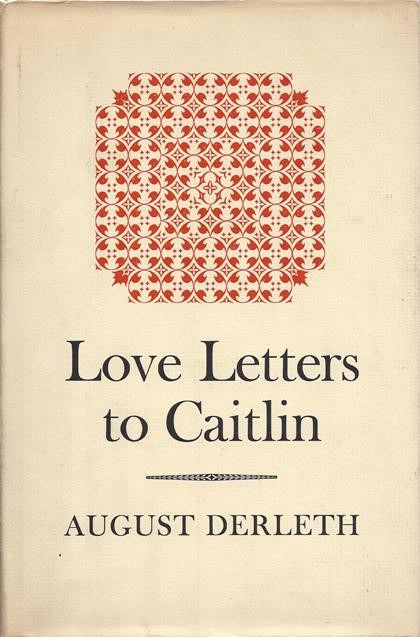
But the book that might be the rarest — the book the collectors should want to acquire if they only knew more about it — may turn out to be the very last book published with Derleth’s byline in his lifetime: Love Letters to Caitlin.

Cover to the rare book Love Letters to Caitlin

A May-December romance in Derleth’s life (with a lover scandalously younger than he) had become the impetus for two final heart-felt Prairie Press collections, Caitlin (1969) and The Landscape of the Heart (1970), and for that last little goodie, Love Letters to Caitlin, issued under the auspices of Peter Ruber (1940-2014) and his Candlelight Press of New York, only a short time before Derleth himself would pass away on July 4, 1971.

Ruber had been working closely with Derleth to publish the author’s non-genre work under the Candlelight imprint since the early 1960s. Though Prairie’s Caitlin and Landscape, at 400 and 450 copies respectively, had gathered Derleth’s recent love and sex poems, he had just presented Ruber with something better. Ruber announced Love Letters to Caitlin in a catalog that appeared ca. 1970-71:

Readers who remember Derleth’s clandestine masterpiece of love lyrics called Psyche and the Caitlin love poems, have an unusual literary treat in store for them. Here are excerpts from love letters written over a period of two years, revealing an affair with all its passion, tenderness and candor. It is not a book for the puritanical reader, and we urgently recommend that only fully mature readers add this book to their shelves. This is a large and exquisite limited edition, handset type, printed and bound by hand with imported papers by the famed Prairie Press.

Ruber knew fans would remember Derleth’s Psyche, one of his earliest Prairie Press releases.

Sadly, subsequent events conspired to derail plans for Love Letters to Caitlin. In fact, many years swept by before Paul Spencer, in 1981, would unwittingly renew interest in the title, describing to readers of that year’s first issue of the August Derleth Society Newsletter a “curious item, somewhere on the border between published and unpublished.”

Spencer apparently contacted Ruber and could detail the book “produced completely by hand, in an edition of 750 copies, by Carroll Coleman’s Prairie Press,” but added how “Coleman was stricken with a heart attack after delivering less than 100 copies to Derleth in 1971 as part of his advance on royalties.”

But then more years passed until Ruber himself in a letter dated November 26, 1988, which was excerpted in a 1989 issue of the Newsletter, tells a somewhat different story:

The Caitlin book was never released. At the time of his death, all the pages had been printed, and three or four copies had been hard-bound by the Prairie Press to illustrate the finished product. Derleth’s lawyer suppressed the publication…

Derleth’s attorney — according to August’s daughter April, who wrote to me personally — enjoys a checkered record for “putting away” Derleth items for safekeeping. Of course it is quite possible he merely believed the subject of Love Letters to Caitlin could damage the author’s reputation.

In 1994, Ruber was back in the picture, working with the heirs in the author’s beloved Wisconsin village of Sauk City, with the goal of returning Derleth to print. Ruber’s visits to Wisconsin at the time may explain how Richard H. Fawcett, a Derleth Society board member, could recount these tantalizing bits in that year’s publications:

Love Letters to Caitlin came out two weeks before Derleth died. He had given out only 12 copies. All others were boxed and disappeared, under the supervision of his attorney. Someone might have to die before this will become available.

Two more decades have since passed, but the questions remain: how many copies are (or were) there of Love Letters to Caitlin? Just those three or four used to illustrate the suggested binding that were delivered along with unbound sets of pages that could number anywhere between 100 to 750?  Or were 12 copies bound, as Fawcett may have discovered?   

During these two decades, there is only this to report: a bookseller in Greensboro, NC, apparently turned one up and subsequently listed it for sale on AbeBooks in 2010; the ad there states, “Two hundred were supposed to have been printed, but it was never officially released and many copies were destroyed. It is estimated that only 20 or so copies survived.”

(What did the bookseller ask for the book? Merely $3,500.00!)

And this: the story of a second copy turning up in Wisconsin and listed on sale for only $200.00, which sold immediately to another bookman who knew the score and then sold it himself for the equivalent of $1,500.

I knew this dealer and asked him about Love Letters to Caitlin. He said,

It looks like Coleman at Prairie Press was hired to do the printing for Ruber at Candlelight Press — not unusual for a small printer/publisher to take on job work for other publishers, most of whom were not printers. There is no evidence of the title/copyright page being a cancel or having been altered. Furthermore, the book proves that copies went out to the trade — there is a label from Kroch’s & Brentano’s on the rear jacket panel. It’s possible that the print run was quite small, possibly only one or two hundred — the Prairie Press poetry collections were only 200-500 or so each….

So, might Love Letters to Caitlin turn out to be rarest of all the books August Derleth one way or the other helped produce?

Only time will tell.

But the book, if you want a copy — to select a proverbial comparison that is darn appropriate for Wisconsin — is less common than hen’s teeth.

John D. Haefele contributed this article.


Allied Authors mourn the loss of Betty Ren Wright

Betty Ren Wright, a longtime member and very dear friend of the Allied Authors of Wisconsin, passed away Dec. 31, 2013, at the age of 86. The full obituary is available in The Journal Times of Racine.

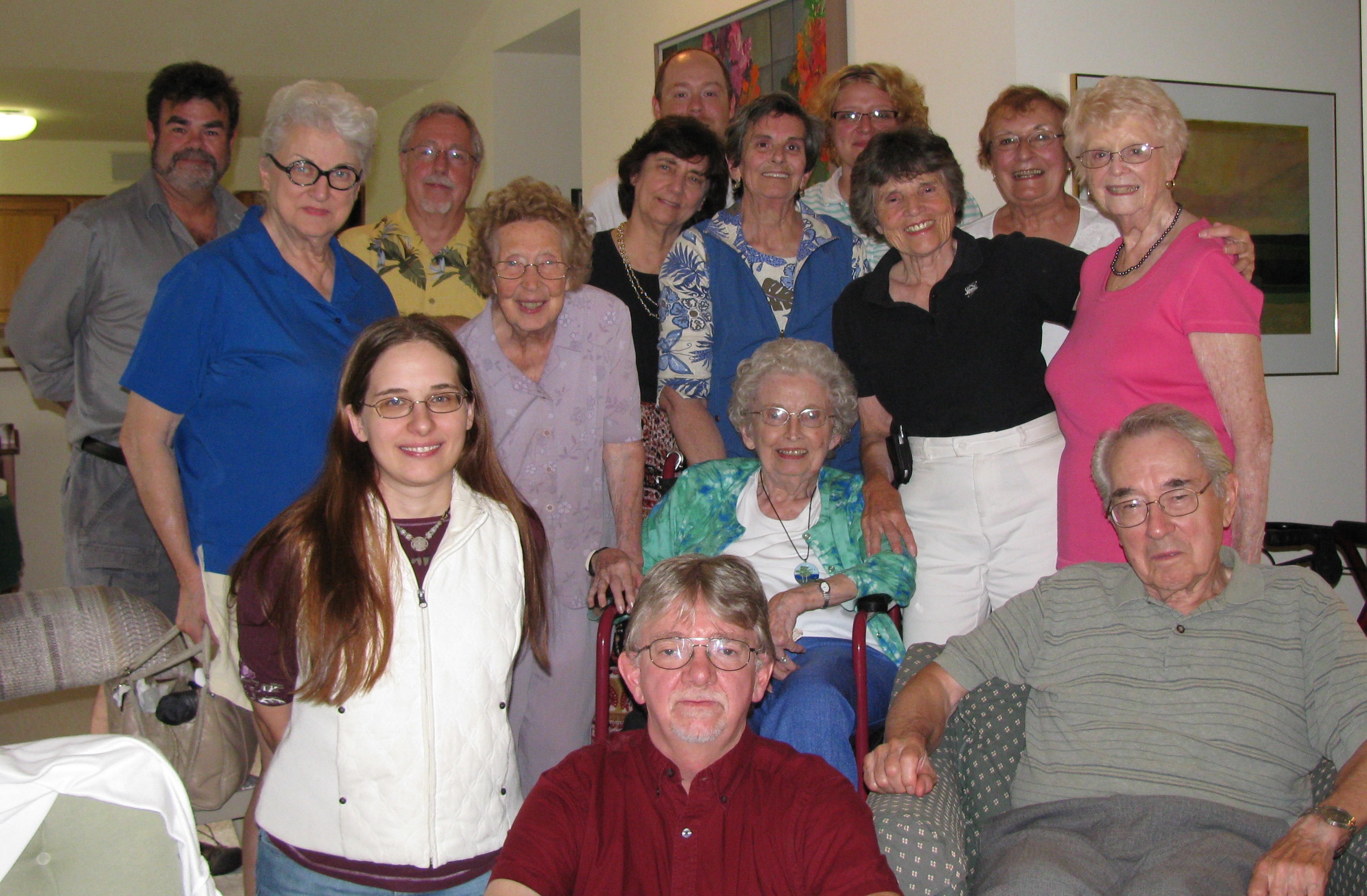
Betty Ren Wright (seated in the middle) surrounded by fellow members of Allied Authors at a recent meeting she hosted.

Betty Ren Wright (seated in the middle) surrounded by fellow members of the Allied Authors of Wisconsin.

Friends and family members have left their sentiments in the newspaper’s online guestbook, which includes this message by AAW member Jack Byrne:

“I was doubly blessed in that I enjoyed both a business relationship and personal friendship with Betty Ren. From our first meeting in the mid ’80s right through our last telephone call in mid-December, she was one of the kindest, warmest and most giving people I’ve ever met.

“Dedicated to writing and writers, she hosted a recent meeting of the Wisconsin Allied Authors, generously sharing both her home and her creative and professional acumen with other members. A Writer even then, as health issues quietly loomed for her, she shared her ideas and plans for a new book. While that book shall remain unfinished, Betty Ren’s life was a masterpiece filled with life, love, family, lasting friendships, personal losses, professional successes and the adoration of the countless children worldwide who devoured her many books.

“We will miss her.”

More information about Betty Ren is available in this announcement. A bibliography of her many books is available here.


Exciting debut of new children’s adventure hero

A novel little book with the odd title The Pajamazon Amazon vs The Goofers Twofers popped into my procurement window on the Amazon.com website (of all places).

An intriguing little goodie, I thought, and here is its synopsis:

“V.V. never gets any good presents from her grandma. And the ugly FOOTY pajamas that arrive for her seventh birthday are the worst! So imagine V.V.’s surprise when the PJs turn out to be magical… But will her new superpowers be enough to stop a couple of troublemakers whose fun and games go too far? As the Pajamazon Amazon, V.V. must find a way to rid her neighborhood of the Goofers Twofers — and do it without getting herself into trouble too.”

The Pajamazon Amazon vs The Goofers Twofers by David and Stephanie Williams

The Pajamazon Amazon vs The Goofers Twofers by David and Stephanie Williams

The cover art by Alyssa Riegert (BrownBoots Interactive) was equally compelling, so I sent the reasonable $6 plus postage into the ether and within days received a handsome trade-sized paperback written for second- and third-grade readers as well as their parents.

But, of course, Stephanie and David Williams belong to Allied Authors of Wisconsin. Moreover, all AAW members have been following their progress since the project officially kicked off in March of 2012 — “officially” because in a singular fashion, the Pajamazon Amazon concept had its inception years earlier, when the authors would get their infant daughter, Gwendolyn, ready for bed by putting on her onesie pajamas and joking about her super-hero alter ego.

Gwen, who is now eight, drew the book’s delightful set of black-and-white interiors, which fans can also see in full color at www.pajamazonamazon.com.

The Pajamazon Amazon is Stephanie and David’s first attempt at co-authoring a piece of fiction and their first foray into print-on-demand/self-publishing. The couple developed the story’s plot and characters together but alternated writing the chapters — each picking the story up where the other left off.

Allied Authors members (and children’s literature experts) Fern Ramirez and Betty Ren Wright served as “beta readers.”

The Pajamazon Amazon vs The Goofers Twofers is a children’s chapter book about a girl with magical pajamas. Not unlike many iconic costumed heroes in their earliest adventures — e.g., the teenaged Spider-Man — the Pajamazon Amazon must learn an important lesson (to use her magical powers selflessly rather than selfishly) before confronting a truly squirrely threat.

The book was published through CreateSpace in December 2013 and is available at Amazon.com.

John D. Haefele contributed this article.

Editor’s note: The Pajamazon Amazon vs The Goofers Twofers is no longer available for purchase. Here’s why.


What aren’t your characters telling you? (And what aren’t you asking them?)

A few months ago, I was talking to a friend who is trying to write a story. She has characters, plot and setting in mind. She even has a few scenes mentally scripted out.

Overall this lady has a start to a book. The difficult issue at hand is starting the process of writing itself. She knows the characters in passing, but not well enough to get in their heads and let the words flow out.

So I shared with her a tip that the Allied Authors of Wisconsin shared with me: Interview your character.

I thought it would be easy enough. Just imagine yourself in a room with this other person and ask them questions. I’ve done it before, and it works great.

Then, a few weeks ago, we were eating sushi and talking about life. I brought up her book and asked how it was going. Miserable, she confessed that she had gotten nowhere from the last time I talked to her. Apparently, she put the heroine in a room, and the gal just crossed her arms, refusing to talk.

“OK, what did you ask her?” I asked.

The questions were complicated and required the character to relive painful memories or detail out descriptions of her life — things that would be hard for any person to adequately answer in real life, especially to a stranger.

It was at that point I knew that something I thought would be simple had been taken to a level of complexity I never anticipated.

“Don’t start with the hard stuff,” I suggested. “Get her to open up with the easy things.”

“What easy things?” she asked.

And I started to list off some simple questions.

  • What’s her favorite color and why?
  • What does she like to eat?
  • What does she do in her spare time when at home alone?
  • Whom does she talk to?
  • Does she read? If so, what?
  • What kind of music does she like?
  • What’s her nickname, and who gave it to her?

This progressed into more detailed questions. However, the restaurant was closing, so we made a promise to meet on the weekend, and I would help her through the interview process.

That Sunday we started with her heroine and the male counterpart. The questions were simple at first, like the ones from earlier in the week. Eventually, they became more detailed, more personal. The very cores of the characters were examined, and painful past events, guilty feelings, and revelations that my friend had never known about her characters came to light.

In four hours we did more than what had been accomplished in the prior months.

Now this is not to say I am a miracle worker. I am not. This gal could have done the whole process on her own. The problem was overthinking the solution and making life far more complicated far too quickly.

Long story short, here are some things you may want to keep in mind when starting an interview with a character:

  1. Start out with easy questions — topical things that help you flesh your character out.
  2. Then get into more detailed questions. “Why,” “when,” and “how” are fantastic vehicles to dive deeper into a character’s psychosis.
  3. Ask the tough stuff once you have a better impression of who the character is in your mind. Even the little details that seem superficial can mean a lot.

For example, her character loves to watch classics movies and movies from the ’80s because that was what she used to watch with her parents before they died. Why is this important? The character is holding on to her past too tightly and is trying to remember all the good things about her childhood while punishing herself with the same memories.

This information came from the questions “What do you like to do in your spare time?” “Why do you do this?” “How long have you been doing this?” and “What do you feel when you do this?”

As a side note, if you have multiple characters and one refuses to talk…stop the interview. Move to the next character. You may find that you learn more by asking your other characters for their impressions of the silent one. Later on, go back with that uncooperative character and tell them what the other characters’ impressions of him/her are. You may find your silent partner starts talking.

If they don’t, well, silence can be golden. Maybe you learned more about that person than you ever thought you would, even with a “failed interview.”

Also, although the process might be unfamiliar, never feel stupid about this process. If need be, write up a list of questions and have someone else ask them instead. Then you can answer for that character.

Personally, I prefer to just sit in the room of my mind and not only listen to what the character is saying, but what they are doing and how they look. Body language is a marvelous thing, even imaginary body language. Your characters may have various tells and quirks that they don’t even know they have. One character of mine, Zander, likes to chew on his hair. He doesn’t realize he does this. How do I know? I watched him do it while interviewing him.

As you progress, you may want to have characters that are close to each other sit in subsequent interviews together. Their speech patterns, their body language, and even their interaction can be valuable.

For instance, when I did this with Zander and his sister Gwen, I realized that Gwen would lightly smack Zander’s shoulder when he started chewing on his hair. She never said anything, but it was how she reminded him not to do that. Gwen and Zander are both introverts, but while Zander shrinks inside himself and lets his sisters do all the talking, Gwen will force herself to be a happy and gregarious person. But they only take on these roles when they are together.

It can get complicated, but starting simple can take you further than you think. As the saying goes: you must learn to walk before you can run.

Alexia Lamont contributed this article.