Author Archives: Allied Authors

Bibliography of Betty Ren Wright’s books now posted!

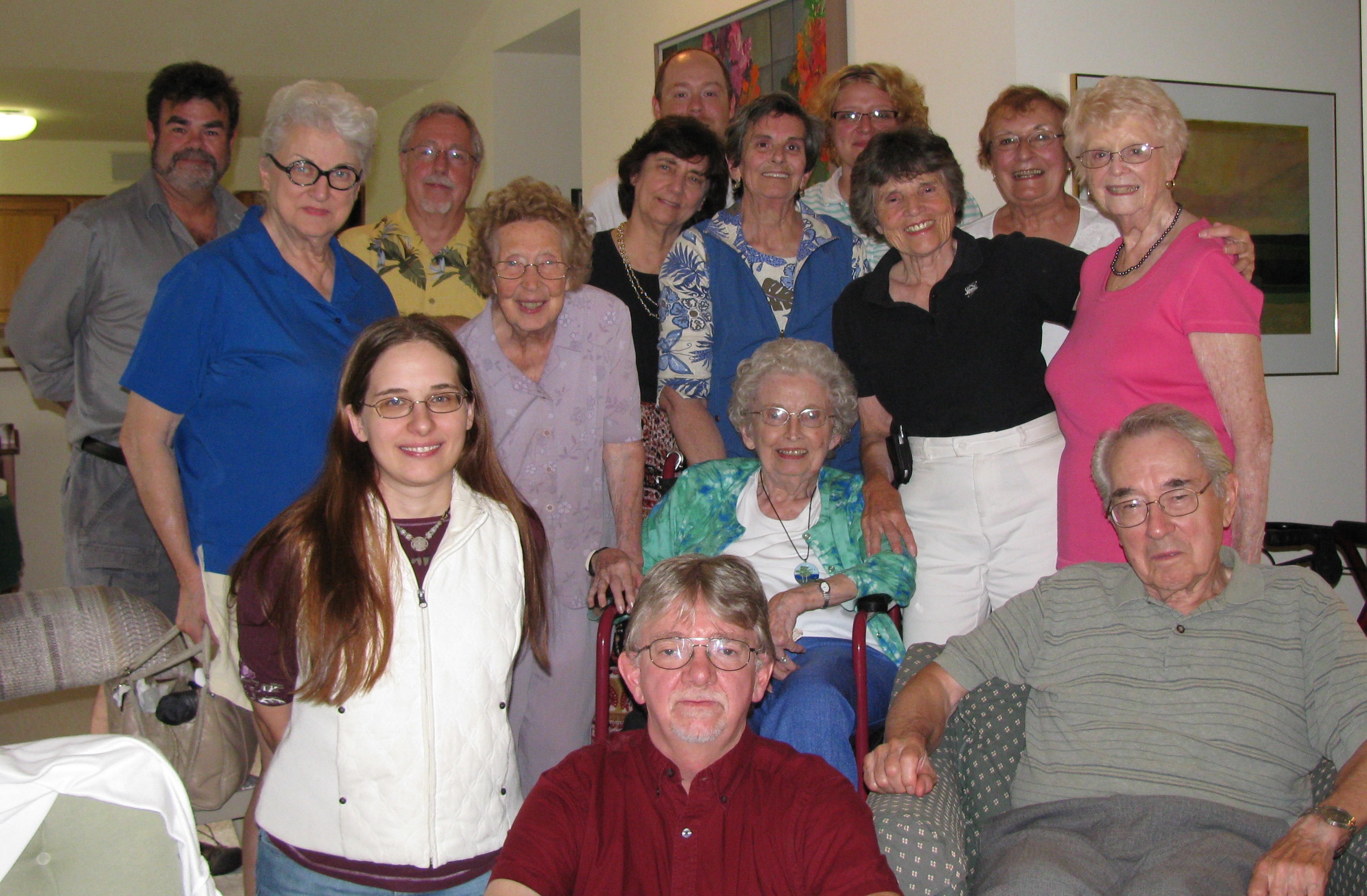
Betty Ren Wright (seated in the middle) surrounded by fellow members of Allied Authors at a recent meeting she hosted.

Betty Ren Wright (seated in the middle) surrounded by fellow members of Allied Authors at a recent meeting she hosted.

Betty Ren Wright, currently mulling over ideas for her next novel for young readers, dreamed about writing stories and books almost as soon as she was old enough to read them.

For many years she was a children’s book editor with Western Publishing; during that time she wrote the texts for a number of picture-storybooks. She also published adult short fiction in a wide variety of magazines. Soon after her marriage to Wisconsin artist George Frederiksen in 1976, she left editing to concentrate on writing novels for boys and girls.

Her third and quite possibly best known book, The Dollhouse Murders, remains a popular ghost story and has never been out of print since its 1983 publication; it’s won numerous awards, been published in dozens of languages, and a dramatic version was released a number of years ago.

Delighted to find that so many readers like ghost stories as much as she does, she has continued to write them, interspersed with other kinds of suspense and adventure stories. Betty Ren lives in Racine, Wisconsin and remains a long-time member of the respected writers group Allied Authors of Wisconsin.

The bibliography is a work-in-progress. We hope to add short fiction and nonfiction in the future. Additions, corrections and comments are welcome and can be sent to allied-authors@hotmail.com or Denysbarry@aol.com.

Betty Ren Wright’s Books

Jack Byrne submitted this article.

John D. Haefele compiled this bibliography.


‘Look Behind the Derleth Mythos’ makes waves

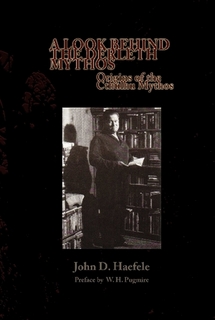
Book cover

A Look Behind the Derleth Mythos: Origins of the Cthulhu Mythos by John D. Haefele

Allied Authors of Wisconsin member John D. Haefele’s first foray into book-length literary criticism has made quite an impact.

In the months following the release of A Look Behind the Derleth Mythos: Origins of the Cthulhu Mythos — Haefele’s study of August Derleth’s contributions to H.P. Lovecraft’s shared system of lore — the book has received a number of positive and balanced reviews, including some early praise from literary critic Don Herron.

According to Herron, “(Haefele) is taking on the almost thankless task of defending Derleth, whipping post for recent generations of Lovecraft scholars, and does a great job of it…”

“Thankless” might be putting it mildly, in light of one scathing review written by leading Lovecraft scholar S.T. Joshi. “Lovecraft Literary Feud: S.T. Joshi Rebuts John D. Haefele,” an article by Peter Cannon in Publishers Weekly’s news blog, sums up Joshi’s reaction and links to his critique.

After several invitations from Lovecraft scholars, Haefele presented his response to Joshi’s rebuttal on Herron’s website.

However, the vast majority of feedback has been very encouraging, including these excerpts:

“Haefele cites abundant secondary sources to support his arguments, and in many cases turns the words of Derleth’s sharpest critics back against them. This book does not resolve the controversy over Derleth and his handling of the mythos, but it does present its key issues from a different and often enlightening perspective.” — Publishers Weekly

“I appreciate authors that do their research, and Haefele certainly has done that; I also appreciate writers who know how to write, and Haefele fulfills that function handily.” — Brian Leno, REHtwogunraconteur.com

“I don’t expect this book to rehabilitate Derleth in the current Lovecraftian community. It is a shot fired by a fan and full of much forgiveness, but it is well researched and well thought out. It is an ‘untimely meditation’ in Lovecraftian studies. But it gives a great intellectual history of Arkham House and the dedicated work of an individual who made sure certain cultural artifacts survived. The book is a solid contribution to scholarship about the evolution of the weird tale in America — covering not only literary efforts, but commercial ones as well. As writers our fate is bound up in the presses that publish us.” — Don Webb, New York Review of Science Fiction

A Look Behind the Derleth Mythos, published by H. Harksen Productions, can be purchased at Amazon.com, Barnes & Noble and Lulu.com.

Haefele is currently working on his next book.


Ramirez’s abundant bibliography now available

A new link has been added to the “Our Members” section, below the name of Allied Authors of Wisconsin member Thomas P. Ramirez. This is both a first and substantial step in compiling the complete bibliography of Tom’s work.

Thomas P. Ramirez

Thomas P. Ramirez

Nearly all of Tom’s 150-plus novels were issued under pseudonyms (e.g., Tony Calvano) or publishers’ house-names, which has proven to be an obstacle to recognition. The novels, averaging perhaps 225 pages or roughly 50,000 words each, tally a total of 7-8 million words.

Tom was a later-day “pulp smith,” writing erotic novels during the two decades following the demise of such magazines. The titles, which are shocking by today’s standards of political correctness, were usually supplied by the respective publisher. Most were written-to-order as pornographic novels during the 1960s and early ’70s, vividly describing with words what vintage mass-market paperback covers had, for decades, thrived on provocatively suggesting.

Despite this signal purpose, what could be overlooked is the careful plotting, thorough research and (for those of us who lived then) the authentic 1960s patina that went into the books. Each is written with captivating verve that compels reading.

Tom was ultimately drawn into the industry’s beleaguered history, defending free speech (more on that here: https://allied-authors.org/our-members/thomas-p-ramirez/), but eventually as the written word gave way to the VCR and other modes of delivery, he moved on, toned things down and entered the mass-market mainstream. There he produced several highly regarded Phoenix Force action books and even several soap operas for a Ballantine series.

The bibliography is a work-in-progress. We hope to add short fiction and nonfiction in the future. Additions, corrections and comments are welcome and can be sent to allied-authors@hotmail.com or Denysbarry@aol.com.

John D. Haefele submitted this article.


Watch out for these five overused words

When a fledgling writer first takes a stab at the craft, he or she is apt to make a few fundamental mistakes.

One such error is assuming that the more words one uses, the better.  Perhaps it stems from penning so many papers in high school and college.  After all, most essay assignments come with word or page quotas.  A student quickly learns to cram in filler words to make sentences extra robust.

And then...

“And” and “then” can cause problems on their own. But when they team up, watch out!

And don’t get me started on those lovely long words that take up half a line all on their own!

Academic writing aside, most folks who concentrate on fiction and creative nonfiction strive for the opposite.  Simple, straightforward syntax rules the day not only because the writing reaches a broader audience, but also because even advanced readers tend to prefer tight, fast-paced prose to a narrative that is drags due to excessive words.

(Don’t get me wrong.  There’s nothing wrong with challenging the reader.  But few people gravitate toward fiction that reads like a dissertation.  It’s as much a matter of tone as a matter of composition.)

The first step to tidying up a manuscript is finding the words, sentences, and even paragraphs that impede a reader’s progress.  A writer must measure every phrase carefully and decide whether it moves the story forward—either by advancing the plot or by presenting pertinent information about characters, setting, and so forth.

As with most aspect of writing, the devil is in the details, and often it’s the smallest, most innocuous words that clutter up clauses.

Here are five words that appear more often than necessary and should be the first on any writer’s chopping block when tightening up his or her work:

Then

“I did something.  And then I did something else.  And then…  And then…”

The problem with “then” is that it doesn’t have much intrinsic value.  Readers assume that, unless otherwise indicated, the actions occur in chronological order.  The event in one sentence precede the events in subsequent sentences.  So in most cases, “then” is redundant.

Despite its semantic shortcomings, “then” occasionally can be helpful in terms of sentence structure variation, rhythm, and clarification.  Just be sure to use it sparingly.

Note: if writing in the present tense, the same goes for “now.”

Also

Like “then,” “also” seldom adds anything meaningful to a sentence.  It belongs to a family of adverbs that show a relationship between ideas, but like its relatives “both” and “either,” “also” can quickly cause sentences to slog, especially if used habitually.

Again, a reader understands that when two thoughts are separated with a conjunction—particularly “and”— the second item also belongs in the collection.  The same is true for the context among sentences.  There’s seldom a need to start a sentence with “also,” as demonstrated below.

Also, “too” and “as well” are just “also” in disguise.

And

I challenge anyone to write a story of any substance that completely avoids the word “and.”  The result, I posit, would be awkward at best.  But while conjunctions like “and,” “or,” and “but” are essential to the English language, “and” can become a crutch like the others on this list.

Notice my what-not-to-do example for “then”: “I did something.  And then I did something else.  And then…  And then…”

Not only does “and” like to tag team with “then” to create redundancy, but also it encourages run-on sentences.  “And” also appears when a writer lists a series of items or actions.  While there’s nothing inherently wrong with series, too many of them can make a scene sound more like it belongs in an instructional manual than a manuscript.

Consider this example:

“I grabbed my coat, opened the door, and slammed it behind.  On my way to work, I stewed over the argument I’d just had with my girlfriend, swore at the sluggish traffic around me, and fumed at the thought of what awaited me at work.  Frustrated and weary, I stomped to my desk.”

That’s three “ands” in three sentences, and while there’s no crime in that per se, the idea of grouping actions—and emotions—gets old very quickly.  Yes, combining the verbs “grabbed,” “opened,” and “slammed” in a single sentence is quicker than dedicating three separate sentences to the motions, but employing too many of these “grocery lists” grows wearisome.  Either space them out or determine which actions can be cut—and likely remain implied.

(For that matter, we don’t even need “frustrated and weary” in the last sentence because we already know the protagonist’s mood from prior sentences, and “stomped” communicates the emotions effectively on its own.)

Said

When it comes to speech tags, “said” is very much in vogue.  In fact, novice writers often get scolded for using fancy variations, such as “stated,” “declared,” “reported,” and “told.”

And yet, when a writer intersperses action or deftly uses voice—via word choice, sentence structure, etc.—to otherwise indicate the speaker, “said” just gets in the way.

More on that here.

All in all, reducing the number of speech tags is an easy way to reduce the word count and pump up the pace of dialogue.

Was

“Was”—and “is,” if you prefer the present tense—can present like a plague if you’re not wary.  Just because any given sentence can contain some form of “to be,” doesn’t mean it should.

Action verbs are always stronger than copular verbs.

Let’s look at that last sentence as an example.  I could have said, “Action verbs always dominate a sentence, whereas copular verbs simply connect a subject to the predicate.”  The semantics aren’t identical, but the latter gave me an opportunity to be more specific and more creative.

Another example:

“I was so hungry that I ate the whole box.” vs. “I devoured the entire box.”

Not only does the second sentence lose a few unnecessary words, but also it is arguably more impactful because it uses “devoured” instead of “was so hungry.”

Beware of the copular verb’s clever cousins, modals: “can,” “could,” “might,” “must,” “should,” etc.  Used in moderation, copulars and modals are harmless; however, when relied upon too regularly, they are bound to let you—and your readers—down.

I suspect every writer has his or her own stable of overused words or a particular construction he or she employs too often.  How often is too often?  However many times it takes a reader to become distracted by it or otherwise bogged down by it.

For instance, I used the “not only…but also” sentence structure three times in this relatively short post.  If it didn’t serve such a fine example of my final point, I’d likely go back and find other ways to express the same thoughts.

Another example from my fiction writing is the word “eyes.”  For some reason, whether giving a character’s description or trying to convey emotion during dialogue or other action, I default to calling attention to people’s eyes.

But now that I’m aware of this tendency, I always stop after typing the word “eyes” and decide if there’s a better way to proceed, possibly by employing a different sensory description.

The five little words outlined above don’t do much harm on their own.  Their danger comes from numbers.  Pruning a handful of these small words from a short story or avoiding them throughout a novel can add up and result in a leaner, meaner manuscript.

The best writers don’t jack up their word counts with filler words.  They understand that true skill is conveying meaning with fewer words, not more.

David Michael Williams contributed this article (reprinted with permission from http://david-michael-williams.com/2013/06/20/watch-out-for-these-five-overused-words/).


AAW member’s 30-year-old book reviewed anew

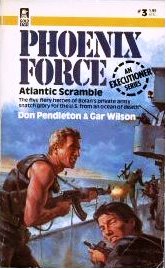
AAW member Thomas P. Ramirez ghost wrote this and several other Phoenix Force novels in the 1980s.

AAW member Thomas P. Ramirez ghost wrote this and several other Phoenix Force novels in the 1980s.

Evidence that books are eternal, a novel written in 1982 by Allied Author of Wisconsin member Thomas P. Ramirez  was recently reviewed at Chess, Comics and Crosswords.

The review of Phoenix Force: Atlantic Scramble appeared as part of the blog’s  “Friday’s Forgotten Books” feature.

Ramirez ghost wrote the book, along with several other installments of the action-packed military fiction series.

Read the full review here.


When it comes to dialogue, don’t trust the word on the street

One of my earliest college writing assignments involved a little espionage.

Having spent plenty of time playacting the part of spy in my youth and, in later years, transplanting such imaginative adventures to written page, I eagerly embraced the challenge my professor put forth.

????????????????????????????????????????????????????????????????????My mission: to choose a random conversation between two people, eavesdrop and write down every word.

Later that day, I lingered in a classroom building’s lounge where fellow students were wont to while away time between classes, catching up on reading assignments, cramming before quizzes, or just chatting with classmates.

Today, I couldn’t tell you much about my marks other than the fact that they were young women.  I recall even less about subject of their conversation.  Their gossip meant very little to me because I knew nothing about them or the people they discussed.  Nevertheless, I surreptitiously jotted down every word.

Every false start.  Every verbal crutch.  Every grammatical violation.

When reviewing my transcripts later, I came to a few conclusions. For one thing, most people are far from eloquent.  When engaged in casual conversation, we interrupt one another.  We even interrupt ourselves.  Occasionally, we use the wrong words.  And if counted how many “ums,” “ahs,” and “actuallys” sprinkled throughout our speech, we’d be amazed.

In other words, if a writer were to accurately capture human communication and translate it to the written word, he/she would end up with a string of fragments and incomplete thoughts through which a reader would inevitably struggle.  Most of the time, the result would be an incoherent mess.

Which, of course, was the point of my top-secret assignment.

This lesson was reinforced in later years when I worked as a reporter.  Oh sure, some people are capable of providing the perfect quote, a sequence of phrases that succinctly sums up their perspective on a given topic.  But most of us use far more words than we need to. We ramble. We utter copious pronouns because, in the context of an interview, the reporter understands what is meant by “he,” “she,” and “it.”

Yet when the reporter goes back to his/her desk to rearrange the interviewee’s answers and evaluate which quote belongs where in the article, it becomes obvious that there is often a chasm between what people mean to say and what they actually say.  It’s truly a treasure when a reporter gets that perfect, impactful quote.  More often than not, however, the phrases and clauses between quotation marks remain rough-edged, unrefined.

When I made the switch from journalism to public relations, writing press releases allowed me to do something I never dared to do as a reporter: I reworked spokespeople’s quotes.  Quite often, I was encouraged to create such quotes from scratch and later run them past my “sources,” who might add a thought here or make a word swap there.  But the finished result was almost always a clear, coherent (if, at times, clearly artificial) collection of clauses that efficiently and effectively communicated the point.

Unlike how people actually speak…

In fiction, nothing takes a reader out of story quicker than stilted, sterile, and/or sloppy dialogue.  The good news is that you have full control over the words that come out of your characters’ mouths.  Here are some tips for how to handle the infuriating idiosyncrasies of human speech and deliver effective dialogue:

1. Shorten, streamline, then slash some more

Even though people in real life prattle on and on, a writer must be mindful of his or her “word economy.”  That doesn’t mean every sentence has to be reduced to a simple, subject-predicate construction, but short and snappy does wonders for pacing.  A reader’s attention has to be earned, and once you lost it, you might not reclaim it.

Consider each situation.  If two characters are passing each other in the hall at work, they wouldn’t likely engage in a twenty-minute conversation.  But if they’re unwinding at the local waterhole after hours—while imbibed a few alcoholic beverages—then a few run-on sentences might be just what the doctor ordered.

A common error I’ve encountered in rough drafts are conversations that simply go on too long.  Not only do the characters say in three sentences what they could have said in one, but also the subject itself circles back on itself again and again.  The chances of this happening increase dramatically if these artificial people are having an argument.  Real-life bickering is repetitive, but no reader wants to endure page after page of repetitive back-and-forth.

When in doubt, err on the side of fewer words.

2. Intersperse action

Dialogue can be like swarm of locusts, hungrily devouring a scene or even an entire chapter.  That might not be the worst thing in the world, just as long as it doesn’t leave the rest of the narrative desolate and devoid of life.

When a writer really gets into a verbal exchange between two (or more) captivating characters, it’s easy to lose track of everything else.  However, if the result is several consecutive pages of pure quotations, you end up with what I like to call Voices in a Vacuum.

Readers want to experience the story through as many senses as possible.  If a long conversation is needed, remember to plant some action in between speech tags so that the reader has something to” look at.”  And don’t forget the setting.  Where are these people?  Have they really been sitting perfectly still on a couch this whole time?  Is the rest of reality on pause while they bear their souls to one another?  Not likely.

Unadulterated dialogue appeals to just one of the five senses: hearing.  And when we speak in real life, our mannerisms convey meaning as well.  Indeed, body language often says more than our mouths!

Sometimes it can be difficult to silence loquacious characters, but unless their words are moving the story forward in a significant way, get ready to press the backspace key.

3. Replace action

Bad dialogue bogs down the pace; good dialogue encourages momentum.

In an effort to smooth out transitions between straightforward action and dialogue (because dialogue actually is a kind of action), it can be helpful to replace an ordinary description of motion with a voiced reference to an action.

Take this (admittedly ridiculous) excerpt for example:

Professor Improbable laughed wildly.  “With a few minor adjustments, the Chrono Cruiser will finally be ready for its maiden voyage!”

He turned to his slump-shouldered assistant, Rogi, and asked, “Bring me the thermal calibrator at once.”

Rogi reached for one of the many tools scattered on the table and handed a gadget to the scientist, who curtly informed him that he asked for a thermal calibrator, not an infrared coupler.

Rogi tried again and, luckily, got it right.

“Thank you, Rogi.  I don’t know what I’d have done without you these past five years…”

Here’s an alternate approach:

“Mwahahaha!  With a few minor adjustments, the Chrono Cruiser will finally be ready for its maiden voyage!”  Professor Improbable turned to his slump-shouldered assistant.  “Rogi, bring me the thermal calibrator at once.  No, no, no!  That’s the infrared coupler.  Ah, yes, that’s the one.  Thank you.  I don’t know what I’d have done without you these past five years…”

The action is implied in the dialogue, and Professor Improbable—whom we suspect always monopolizes the conversation—can recap his master plan without needless interruptions.  Just make sure you don’t waste the reader’s time by having the dialogue and the narration convey redundant information.

4. Develop voice

Dialogue is perhaps the most intuitive element through which one can execute characterization.  A person’s vocabulary and delivery say an awful lot about him or her.  Casual chats, heart-to-hearts, quarrels, exchanges with random strangers—all of these present opportunities to add dimension to a character.

The goal is to give each character an individual voice, a strong voice that will inform the reader who is speaking even before they get to speech tag (e.g., “said Professor Improbable”).  Consider your character’s culture, education level, disposition, etc. when determining which words ought to come out of his or her mouth.

Just don’t get carried away.  Even if Rogi ends up having a speech impediment, a reader isn’t going to w-w-w-w-want to h-h-h-h-h-have t-t-t-t-t-t-to n-n-n-n-n-n-n-navigate a-a-a-around too m-m-m-m-m-many v-v-v-v-v-v-v-visual h-h-h-h-h-hurdles.  The same goes for representing accents.  Put in an affectation here and a native word there.  Please don’t pump each paragraph full of apostrophes to imply clipped sounds or otherwise butcher perfectly good words.  Subtlety is key.

Dialogue should round out your characters, but rarely can talk-heavy scenes exist solely for character development.  Every word needs to move the story forward, including quotes.

5. Read it out loud

The best way to gauge whether your dialogue rings true is to read it out loud.  Better yet, have someone else read it to you.  Listen for tongue-twisting syntax and garbled semantics.  Listen for flow.  Are the transitions logical?

Listen for sentences that are just too tidy.  Unless your protagonist is a grammar teacher, he or she is going to end a sentence with a preposition now and then.  For that matter, the rules of proper grammar don’t apply within quotation marks.  Awkward, unconventional sentence structure in dialogue won’t reflect poorly on you as a writer (if the rest of your sentences are grammatically sound), though it will send a message about the character in question.

Every good spy knows the best lies contain at least an ounce of truth.  The trick with dialogue, as with any aspect of fiction, is making something artificial come off as natural.  To become adept at writing dialogue, listen to how the people around you really talk and then make it better.

But not too perfect.

David Michael Williams contributed this article (reprinted with permission from http://david-michael-williams.com/2013/05/09/when-it-comes-to-dialogue-dont-trust-the-word-on-the-street/).

Why writers groups still matter

Anyone who has studied literature surely has stumbled upon them: a group of extremely talented writers who came together to exchange ideas, encourage one another, and, sometimes, to form a movement.

J.R.R. Tolkien and C.S. Lewis were members of both the Coalbiters and the Inklings.  Ernest Hemingway, Ezra Pound, F. Scott Fitzgerald, and others were known to gather at the Shakespeare and Company bookstore in Paris.  The Pre-Raphaelite Brotherhood included painters and poets.

These super groups are the stuff of legend and, one might assume, an endangered species in this age of do-it-yourself writing, editing, and publishing.  After all, why waste your time talking with other writers—face to face, no less—when one guy with a computer can do it all these days?

I recently read several blog posts ragging on writers groups, claiming they are, at best, an old-fashioned waste of time and, at worst, a detriment to one’s writing because they implicitly suggest another’s opinion should have an impact on one’s Art (note the capital A).

I beg to differ.

Setting aside the sad notion that writing can often be a lonely pursuit (more on that in “The ‘cons’ of writing collaborations”), there are many ways an author can benefit from writers groups.  But before I expound on that, full disclosure: I am a member of the Allied Authors of Wisconsin, one of the oldest writing collectives in the state and, arguably, one of its best kept secrets.  My view on this matter is biased because of this group of outstanding and supportive writers—and friends.

Yet I realize that not all writers groups are created equal.  So consider these dynamics when selecting—or starting—a writers group.

Education

Have you heard the saying “Surround yourself with people who are smarter than you?”  There’s plenty of truth to that, though I would amend it to this: Surround yourself with people who are smarter, more experienced, and more successful than you.

If you are going to subject your story to a critique, make sure those readers have a fair measure of expertise.  Learn from their missteps as well as their accomplishments.  If you typically struggle with the structure of story, you’ll want someone who has a keen understanding on the craft of storytelling, perhaps an English professor.  And if syntax is your weakness, there’s nothing like a copyeditor to help conquer those grammar gaffes and/or a bibliophile to ferret out pesky clichés.

Whenever possible, find people who have been published and can lend some insight into the business aspects of writing.  And if you can get your hands on an editor or agent, hold on tight and don’t let go!

In short, find yourself a flock of mentors to take you under wing.

Inspiration

When I leave an Allied Authors meeting, all I want to do is go home, plant myself in front of the keyboard, and type away into the wee hours of the morning.  Great writers groups should do that.

I’ve heard horror stories of writers groups that achieve the opposite.  Two friends of mine were members of an organization that sounded more like a sect of sadists than a support group.  Apparently, members took turns mercilessly tearing down one another’s hard work.  My friends eventually quit because they grew tired of hearing how inept they were by people who thought their own work was better than it was.

While every writer needs to grow a layer (or two) of very thick skin, there’s no excuse for tactlessness.  Critiquing should not equate to kicking someone when they’re most vulnerable; on the contrary, constructive criticism mixes praise with opportunities for improvement.

At the end of the day, a writers group grants a writer objective perspectives.  The reader doesn’t know what you know, and getting feedback midway through a novel allows the author to glimpse what a particular reader is thinking and feeling at that precise moment of the story—invaluable insight to be sure!

You don’t have to agree with everything that is said.  Neither do you need to explain every literary decision you make.  Listen, learn, and then decide how to apply what was said (if at all).  If the point of a writers group is to make you a better writer, then your peers’ comments should inspire you to jump back into your narrative and trim, tweak, and/or tread forward with confidence.

If your group instead discourages you, it’s time to move on.

Motivation

When my son was a newborn, I had a great idea for a novel but felt I had no time to dedicate to writing it.  Since I was a part of a writers group, I felt obligated to bring something to the table.  Oh sure, I could have slacked off and missed a meeting here and there, but because I had the opportunity to get feedback from a fantastic group of writers, I just couldn’t stand to squander it.

And so every month, I wrote one new chapter.  Some passages were arguably better prepared than others, but if nothing else, those monthly meetings provided me with deadlines, impetus, and momentum on a project that resulted in a novel that is now represented by an agent.

Without a reason to pursue those one-chapter-per-month milestones, the completion of that novel would have been much delayed or perhaps postponed indefinitely.

On the other hand, beware of writers groups that require too muchresponsibility.  Your network of writers should function as a support system that makes your writing better, not as a “time suck” that detracts from your fiction in the form of excessive, outside-of-class exercises.  If you’re spending hours reading massive manuscripts, preparing a dissertation for each chapter another member submits, and/or running out to the copy shop for copious printouts prior to meetings, then maybe your writers group needs you more than you need it.

Reciprocation

Even if you joined a writers group for mostly selfish reasons—so that you can become a better writer—you do have a responsibility to return the favor.  The best writers groups are those comprised of people who genuinely want one another to succeed.  Sure, there might be some friendly competition and good-natured banter/bashing, but at the end of the day, you owe it to the group to be a giver as much as a taker.

That means attending meetings even though your work isn’t on the agenda, paying attention even if a particular genre or style doesn’t appeal to you, and always giving honest and genuine feedback (even if So-and-So didn’t give your most recent submission a raving review).

The quickest way to destroy the integrity of a writers group is to adopt a me-versus-them approach.  If you want to be supported, you must support others.  If you expect others to cheer you on, then you have to congratulate them on their successes.  And because you (hopefully) played a part in making their writing stronger, their successes become your successes.  Even as you were mentored, mentor those with less experience.

Any writers group is an investment; you can only hope to gain what you are willing to give.

Harmonization

I suspect that the folks who condemn writers groups have had unfortunate experiences with them.  In addition to the aspects addressed above, there is another angle: the “X factor.”

Here’s one example.  If you write romance novels, and no one in the group appreciates that genre at all, then you probably need to find a different group.  But having said that, I urge writers to surround themselves with readers and writers of fiction outside of their preferred genre, too.  The uninitiated tend to catch things others take for granted.

And what about the tone of the meetings?  Is it all business?  Or is everyone OK with an hour of socializing prior to critiquing?  Make sure everyone is on the same page (so to speak) when it comes to the rules, expectations, and goals.

At the end of day, a group is comprised of people.  Sometimes personalities mesh; sometimes they don’t.  Positive attitudes can sweeten the deal, while strong egos inevitably sour the bunch.  If you are willingly opting to spend time with these people, then you should genuinely enjoy their company.

I’m sure J.R.R. and C.S. connected because of common interests, but I have to believe it was more than just business (and their penchant for using initials).  There’s no law that says a writer has to join a writers group to become successful, but I personally have benefited from writers groups both while in college and as a member of the Allied Authors of Wisconsin.  I wouldn’t be the writer I am today without them.

And if some of the literary greats also saw merit in gathering together and exchanging ideas, who am I to disagree?

Do you disagree?  Tell me what you think of writers groups below…

David Michael Williams contributed this article (reprinted with permission from http://david-michael-williams.com/2013/04/05/why-writers-groups-still-matter/).


Writers Poll: Portraying thoughts in fiction


Bloch-Heads

Before publication of Psycho in 1959, before his purely coincident move to California that same year, Robert Bloch cast his spell upon the Milwaukee Fictioneers, that notable group of Wisconsin writers. Its effect began soon after his famous correspondent H. P. Lovecraft passed away in 1937 and endured throughout waning years and the final months in 1954 of the iconic Weird Tales magazine.

In 1987, near the end of Bloch’s life, historian Jack Koblas conducted a 90-minute interview with Bloch (transcribed in The Lovecraft Circle and Others: As I Remember Them, Battered Silicon Dispatch Box, 2012) that touches briefly on this period to reveal a little more of this lost history of the Fictioneers. Under discussion: the 1930s. Subject underway: Bloch’s young friend (future SF & Mystery writer) Henry Kuttner, still a beginner: “You told me,” Koblas reminds Bloch, “that you did something with Kuttner. Did you collaborate with Kuttner?” Bloch answers:

“The Black Kiss,” but he had been trying to sell that story and he couldn’t. He gave it to me and he said, “Do something with it.” So I rewrote it and I used the basic premise that he had, and that was published…. Then I wrote another one for the Milwaukee Fictioneers and one of the writers, who had been a very successful writer of boys’ books, a real good writer, a nature writer, dying to get into Weird Tales. He couldn’t do it. He submitted it. He said, “What can I do?” and I said let me see some of it. He showed me a story and I said I think this will work but I think it would have to be restyled. He said, “Would you collaborate with me on it?” I did, I rewrote it, and it was printed—Jim Kjelgaard, printed as “The Man Who Told the Truth.” Then I did one on the same basis for another member of the Fictioneers, for Strange Stories, Ralph Milne Farley…. (41)

Indeed “The Black Kiss,” bylined “Robert Bloch and Henry Kuttner,” was published in the June 1937 Weird Tales, but this is not Kuttner’s first WT story, though undoubtedly it did help pave the way for others to follow (there would be fourteen more of his own); Kuttner in fact had appeared there nine times already. Kjelgaard had been there, too, logging three individual appearances before “The Man Who Told the Truth” (none identified as collaborations) in 1946, which turned out to be his last. And the same must be said of Farley, who booked eleven stories from 1930 to 1943.

What must have happened is that all of these authors believed they would learn more about their craft through Bloch’s reworking of their stories. Learning from each other was (and is) a hallmark of Milwaukee Fictioneer-Allied Authors, and there apparently was a lot that could be learned from Bloch, who in these pre-Hollywood days chalked up 67 appearances in Weird Tales, equivalent or surpassing numbers elsewhere, and who effortlessly might have landed oodles more had WT not folded.

John D. Haefele submitted this article. (© 2012 all rights reserved)